Photography vs Videography: Which Does Your Business Need?
Choosing between photography and videography depends on what your business needs to communicate, where the content will be used, and what action you want customers to take after seeing it.
Photography works best when customers need to see products, people, spaces or specific details clearly. Videography becomes more useful when movement, demonstrations, storytelling, processes or experiences need to be communicated.
For many businesses, the most effective approach is not choosing one over the other. A properly planned production can combine photography and video to create a broader library of marketing assets.
Photography vs Videography: What Is the Difference?
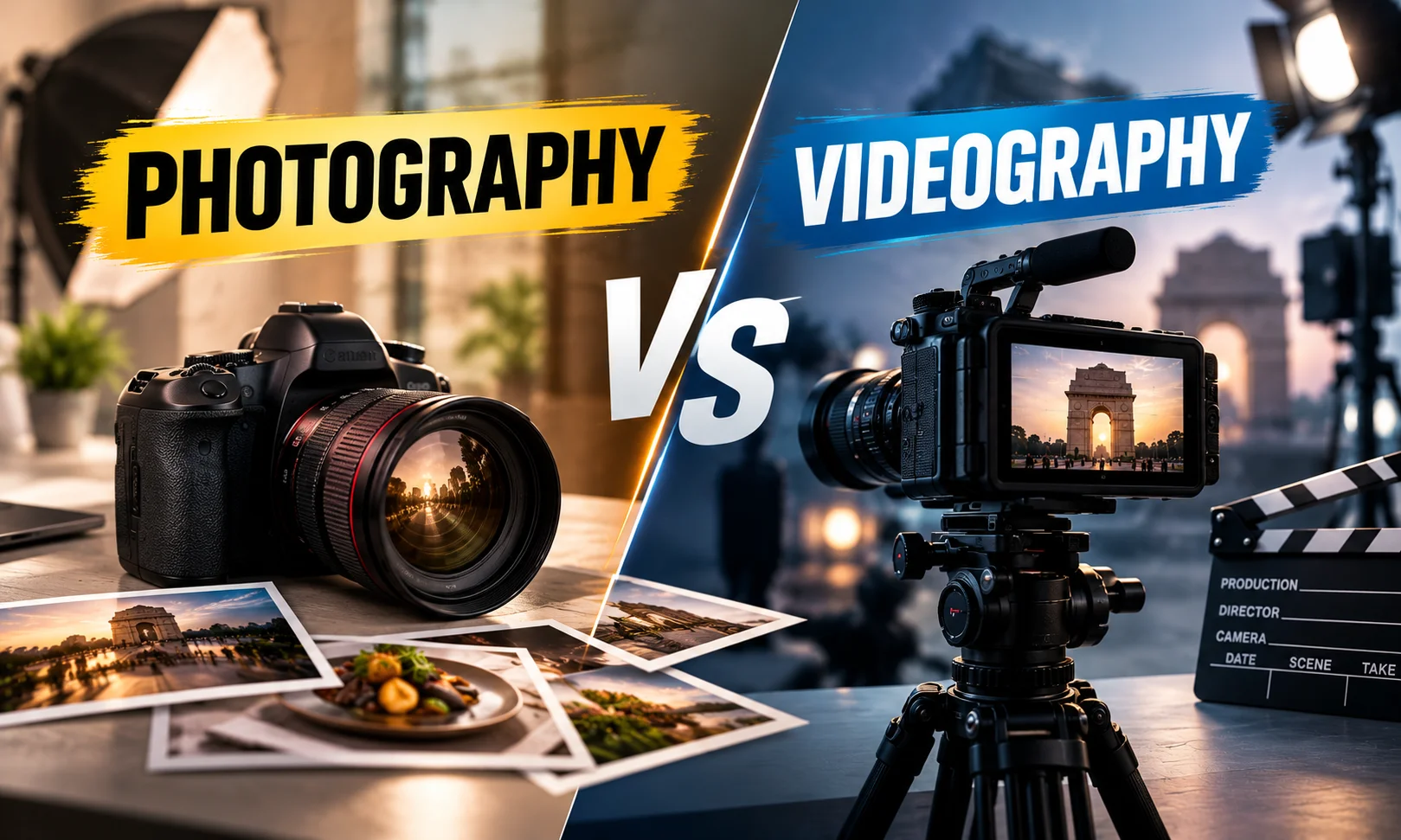
The simplest difference between photography and videography is the way information is communicated. Photography uses individual still images, while videography combines moving images, sound, pacing and sometimes dialogue to communicate an idea or experience.
Photography allows customers to examine a particular subject at their own pace. A product photograph can show packaging, texture, design, details and different angles without requiring the viewer to watch a complete video.
Videography communicates through movement and sequence. A video can demonstrate how a product works, show a process from beginning to end, introduce a person, capture an event or communicate a brand story through visuals and sound.
The choice should therefore depend on the information your audience needs. If the customer mainly needs to see something clearly, photography may be enough. If they need to understand how something works or experience a story, video may be more effective.
When Is Photography Better for a Business?
Photography is usually the better choice when a business needs clear, reusable visual assets that can be placed across websites, ecommerce pages, social media, advertisements, brochures and other marketing materials.
Product-Focused Businesses
Product photography is particularly useful when customers need to examine the appearance, design, packaging, details, variations or physical characteristics of a product before making a purchase decision.
Ecommerce businesses commonly need multiple photographs for each product, including primary product images, alternative angles, detail shots, lifestyle images and photographs showing the product in use.
Websites That Need Professional Images
Business websites often require photographs for service pages, About pages, team sections, case studies, product pages, locations and other important areas.
Photography can provide original images that accurately represent the actual business rather than relying entirely on generic stock photographs that may not reflect the company's products, people or environment.
Corporate and Professional Services
Corporate businesses can benefit from professional photographs of leadership teams, employees, offices, facilities, projects and workplace environments.
These images can support company websites, LinkedIn profiles, presentations, recruitment materials, press communication and other business-facing content where professional visual representation matters.
Hospitality and Food Businesses
Hotels, restaurants, cafés and hospitality businesses rely heavily on photographs to present rooms, interiors, food, beverages, facilities and guest experiences.
High-quality photographs can help potential customers understand the property or offering before making an enquiry, visiting the location or making a reservation.
Businesses Requiring Regular Social Posts
Photography can provide a large library of visual assets for businesses that publish regular social media content. A single planned shoot can produce multiple compositions and subjects for future posts.
Photography is also easier to reuse across different formats because individual images can be cropped, resized and placed alongside different headlines, captions or promotional messages.
When Is Videography Better for a Business?
Videography becomes more valuable when still images cannot communicate enough information or when movement, sound, demonstration, personality or storytelling is an important part of the message.
Product Demonstrations
A product photograph can show what something looks like, but a video can demonstrate how it operates, how it is assembled, how it is used or how it performs in a practical situation.
This makes product video particularly useful for products where functionality, movement or usage is difficult to communicate through still images alone.
Brand Storytelling
Businesses with a strong story, founder perspective, customer experience or distinctive working process can use video to communicate information through people, locations, dialogue, movement and narrative.
A brand film can bring together different elements of a business that would otherwise require many separate photographs and pieces of written content.
Social Media Reels and Short-Form Content
Short-form video has become an important content format across platforms such as Instagram, Facebook, YouTube and LinkedIn. Businesses can use video to create reels, promotional clips, demonstrations, behind-the-scenes content and educational videos.
If your primary goal is to maintain an active short-form video presence, videography should form an important part of your content production plan rather than being treated as an occasional addition.
Events and Experiences
Events are naturally suited to video because movement, atmosphere, conversations, performances, speakers and audience reactions are difficult to communicate through still images alone.
Event videography can capture highlights that can later be used for social media, promotional content, internal communication, presentations and future event marketing.
Businesses Where People Are Central to the Brand
Consultants, founders, coaches, hospitality businesses, agencies and other people-focused brands can use video to communicate personality, expertise and communication style in ways that static photographs cannot fully capture.
Video can show how someone speaks, explains a subject, interacts with customers or presents their approach, making it particularly useful when personal connection influences the buying decision.
When Does a Business Need Both Photography and Videography?
Many businesses benefit from using both because photographs and videos perform different jobs within the customer journey. Combining them can also make a single production more useful across multiple marketing channels.
An ecommerce brand, for example, may need product photographs for product pages while also requiring short product videos for advertisements and social media.
A hotel might use professional photographs for booking pages and websites while using video to communicate the overall property experience, rooms, dining, amenities and atmosphere.
A corporate company may require professional team and leadership photographs for its website and LinkedIn presence while using corporate videos for company introductions, recruitment or marketing campaigns.
The key is to plan both formats together. A combined production can maintain consistency in styling, lighting, locations, products and creative direction while producing different types of final assets.
Photography vs Videography for Social Media
Social media does not require every business to choose between photography and video. The right mix depends on the platform, content strategy, audience and type of message being communicated.
When Photography Works Better on Social Media
Photography is useful for product announcements, carousel posts, team introductions, quotes, educational graphics, brand storytelling, event highlights and visual posts where the information can be understood from a single frame.
Photographs are also practical when a business needs a consistent visual feed and wants to create content that can be reused across Instagram, Facebook, LinkedIn and other channels.
When Video Works Better on Social Media
Video is useful when the content involves demonstrations, people speaking, behind-the-scenes footage, processes, transformations, tutorials, product usage or short stories that benefit from movement and sound.
Short-form videos can also provide more room to communicate a sequence of information within one piece of content rather than relying on several separate photographs.
The Best Social Media Approach
For businesses actively investing in social media, combining both formats can provide greater content variety. One shoot can potentially generate photographs, reels, product videos, behind-the-scenes footage and other assets for future publishing.
If social media is a major part of your marketing strategy, our Photography and Videography Services in Delhi can help create visual assets around your specific content and platform requirements.
Photography vs Videography for Websites
Websites generally need both still images and video, but the right balance depends on the business and the purpose of each page.
Photography is particularly important for product pages, team sections, service pages, project portfolios, accommodation pages, restaurant menus and other areas where visitors need to examine specific visual details.
Video can be valuable on homepages, landing pages, product pages, About pages and campaign pages where demonstrating a process, introducing a brand or communicating an experience adds information that photographs cannot provide alone.
Website photography should also consider image quality, composition, dimensions, responsive layouts and page performance. Large unoptimized files can create unnecessary loading issues, so visual quality should be balanced with practical website requirements.
Video requires additional consideration because file size, hosting, playback behaviour, mobile experience and page performance can affect how effectively video works within a website.
Photography vs Videography for Advertising
Advertising requirements should be considered before production because the creative format influences what needs to be captured during the shoot.
Photography can work well for static advertisements where a product, offer, person or visual concept needs to be communicated immediately. Still images can also provide space for headlines, promotional copy and calls to action.
Videography is useful for advertisements that depend on demonstrations, movement, storytelling, customer situations, product usage or strong visual sequences that cannot be communicated effectively through one frame.
The best format also depends on the advertising platform, campaign objective and audience. A business running multiple campaign types may require both static and video creatives rather than depending exclusively on one format.
What Does Your Business Need for Social Media?
If your social media strategy mainly involves product posts, team photographs, educational carousels, announcements and branded visuals, photography may provide a strong foundation for your content requirements.
If your strategy depends heavily on reels, demonstrations, talking-head content, behind-the-scenes videos or short-form storytelling, regular videography should be included in your production plan.
Businesses publishing consistently often benefit from combining both formats because different messages require different visual treatments. A product launch, for example, can use product photographs, a demonstration video and short promotional clips from the same production.
The important consideration is not how much content you can produce, but whether each photograph or video has a clear purpose within your content strategy.
What Does Your Business Need for Its Website?
For most business websites, photography should be considered essential because visitors need clear visual information about the company, its products, people, services or physical environment.
Video becomes more valuable when the website needs to communicate something that requires movement or sequence, such as a product demonstration, company introduction, customer experience or detailed process.
A service-based business may need professional team and workplace photographs more than extensive video, while a product company may benefit from a combination of product photography and product demonstrations.
The best approach is to identify the purpose of each important website page first and then determine whether photography, video or both provide the clearest way to communicate the required information.
What Does Your Business Need for Advertising?
Businesses running paid advertising should select photography or videography based on the campaign objective rather than simply choosing whichever format is easier to produce.
Static photography can be effective for communicating products, offers and visual concepts quickly, particularly when the advertisement needs to accommodate a headline, product information or call to action.
Video can be more appropriate when the advertisement needs to demonstrate a product, introduce a problem and solution, show an experience or communicate several pieces of information within one creative.
For businesses running multiple campaigns, creating both static and video assets during planned production can provide greater creative flexibility and reduce the need to arrange separate shoots for every campaign requirement.
Photography vs Videography: Which Costs More?
There is no universal answer because photography and videography costs depend on production scope rather than simply the chosen format.
Photography costs can depend on the number of products or subjects, shoot duration, location, equipment, creative direction, styling, number of final photographs and editing requirements.
Videography generally involves additional production considerations such as scripting, storyboarding, camera movement, audio recording, lighting, crew requirements, editing, music, voiceover, motion graphics and other post-production work.
A simple product photography session may therefore cost considerably less than a multi-location brand video, but a large-scale photography production involving many products, models, locations and detailed retouching can also require significant resources.
Instead of comparing photography and videography only by price, businesses should compare the value of the final assets against their intended use. The right production is the one that creates the content required to achieve the business objective.
How to Decide Between Photography and Videography
Start by identifying what your customer needs to understand before taking action. If they mainly need to see a product, person, space or service clearly, photography may be sufficient.
If they need to understand how something works, experience a process, hear someone explain an idea or see a story unfold, video may communicate the information more effectively.
Next, identify where the content will be used. Website pages, ecommerce listings, social media posts and static advertisements often require photography, while reels, demonstrations, brand films and certain advertising formats require video.
Finally, consider whether the same production can serve multiple purposes. If your business needs website photographs, social media reels and advertising creatives, combining photography and videography during one planned production may provide the most practical solution.
A Simple Rule for Choosing
Choose photography when your primary requirement is clear, reusable and detailed visual communication through still images.
Choose videography when movement, sound, demonstrations, personality, sequence or storytelling is important to communicating your message.
Choose both when your business needs a complete visual content library across websites, ecommerce, social media, advertising and broader brand communication.
There is no universal format that works best for every business. The right decision depends on your products, services, audience, marketing channels, content strategy and the specific information you need customers to understand.
Professional Photography and Videography Services in Delhi
If your business needs photographs, videos or both, the production should begin with a clear understanding of the intended use, audience, platforms, creative direction and required deliverables.
The Socially Active provides Photography and Videography Services in Delhi for businesses requiring professional visual content for websites, ecommerce, social media, advertising, corporate communication, hospitality and brand campaigns.
Our production approach can be planned around the content your business actually needs, helping you create photographs, videos and short-form assets that have practical applications across your digital marketing activities.